AI vs Patent Attorney: What Happened When the Claims Were Professionally Reviewed
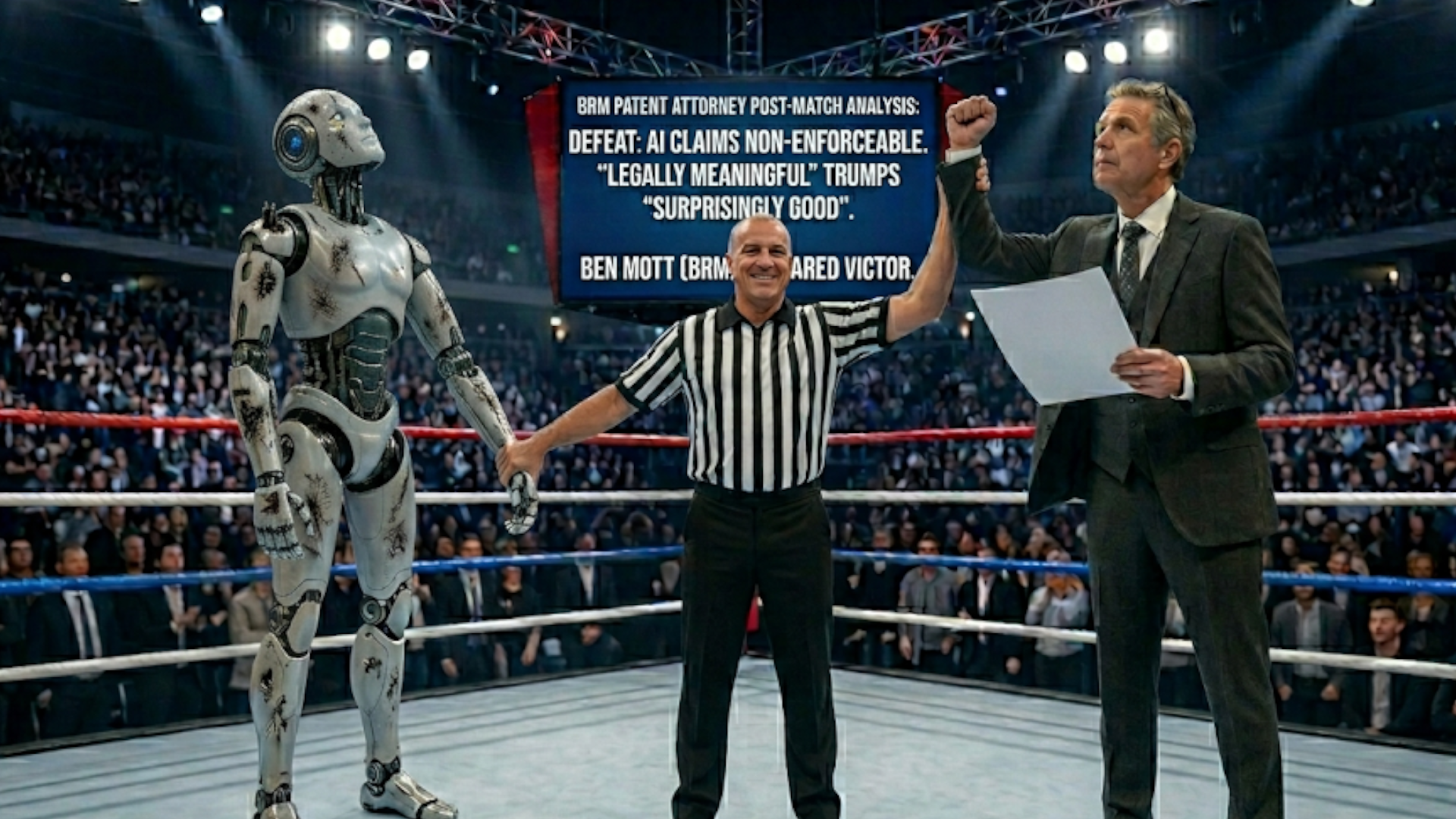
When AI Meets Legal Scrutiny
Following 6 May 2026’s IAA-Vic presentation, the conclusion from the “AI vs Patent Attorney” experiment was far more nuanced — and far more interesting — than many attendees expected.
The original exercise, conducted by independent inventor E. Black, explored whether AI could assist in producing attorney-style patent drafting by modernizing a lapsed mechanical bird-feeder patent into a motorized, weight-activated deterrent system.
What initially appeared to be a relatively straightforward AI-assisted drafting exercise ultimately involved more than 63 pages of conversation logs, iterative prompting, restructuring, technical refinement, and more than 20 hours of work before arriving at what both parties considered even a “semblance” of the intended result.
During the session, patent attorney Ben Mott of BRM Patent Attorneys repeatedly noted that he was impressed not only by E. Black’s writing ability, but also by the persistence and strategic prompting required to guide the AI toward producing something resembling a coherent patent disclosure.
Large portions of the generated material appeared surprisingly sophisticated on the surface, including:
structured independent and dependent claims
broad functional language
technical summaries
references to enablement and prior art
electromechanical terminology and drafting conventions
However, the live analysis also demonstrated the critical gap between producing technical-sounding language and producing legally defensible patent claims.
Both E. Black and Ben Mott ultimately agreed that while AI can assist in translating rough ideas into more coherent technical concepts, the system still failed to produce claims that could be considered legally defensible without substantial professional intervention and review.
The session highlighted one of the major misconceptions surrounding AI-assisted drafting:
Convincing language is not the same thing as enforceable intellectual property.
The experiment also exposed the hidden human cost behind many AI success stories. While the final output may appear polished, attendees learned that reaching that stage required extensive trial-and-error, repeated corrections, strategic reframing, and continuous human oversight.
For E. Black, the project represented not only more than 20 hours of work, but also significant opportunity cost as a professional webmaster and writer, with real financial and productivity impacts resulting from the time invested into the experiment.
Importantly, the discussion remained collaborative and good-humored throughout the evening. Both E. Black and Ben Mott, along with attending IAA members, expressed genuine surprise at how far the AI could be pushed under detailed human guidance — while also recognizing how quickly an experienced patent attorney could identify weaknesses in scope, defensibility, enablement, and claim strategy.
Rather than becoming an “AI versus humans” debate, the presentation evolved into a more useful discussion about where AI currently fits within professional workflows.
The overall takeaway from the evening was clear:
AI can significantly accelerate brainstorming and early-stage drafting, but legal accountability, strategic claim construction, and patent defensibility remain firmly human responsibilities.